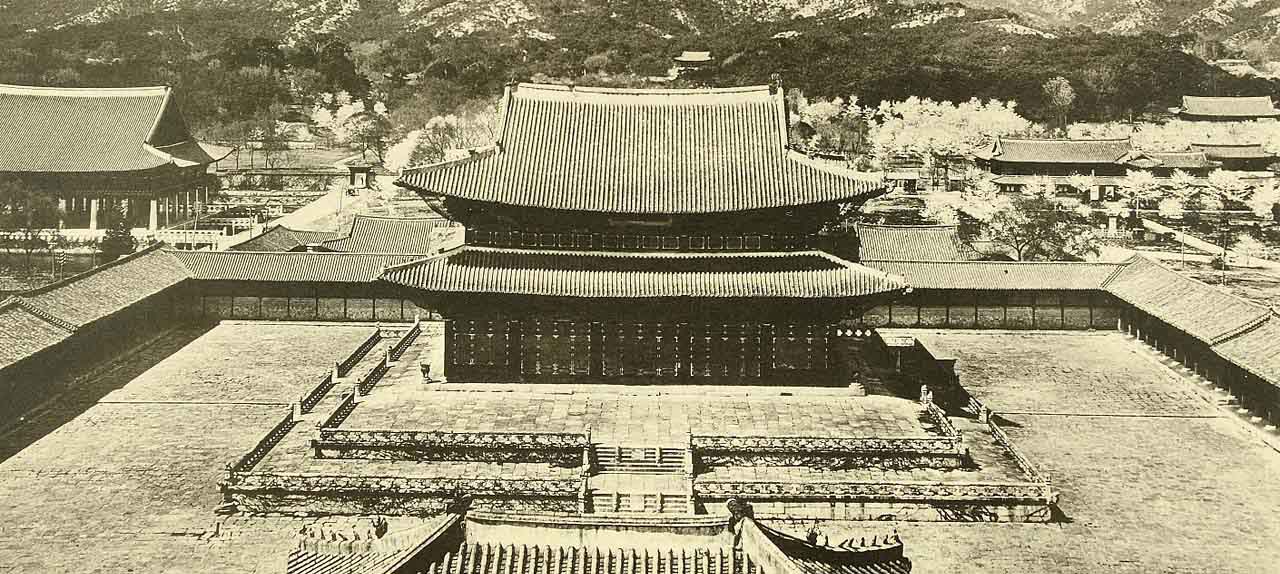
In 1901, the French archaeologist Emile Bourdaret visited Gyeongbokgung. This is how he described the Geunjeongjeon Hall:
“This place, with the thick foliage and black rock of Baegak Mountain in the background, emanates a dignified air.
Joseon architects know how to use the beautiful natural scenery that could itself be a great painting in the buildings. The buildings they build help make the natural scenery around them look even more beautiful. The unique features of the buildings themselves are also noteworthy.” From the 14th to the 16th centuries, important state ceremonies in Joseon were held here. These traditions were revived in the nineteenth century. These included such important occasions as: Coronations, king’s weddings, the naming of the crown prince, official morning ceremonies, and welcoming ceremonies for foreign emissaries…
What about these rectangular stones that are found all over the courtyard? These are markers that indicate the rank of the official who was seated there. During official ceremonies, the king would sit in his seat in Geunjeongjeon Hall while officials would line up in the courtyard next to the square stone indicating their rank and bow toward the king. In Joseon, officials were selected through the civil service examination. Political knowledge was judged on general knowledge and literature. One’s writing ability was also a determining factor.
The king administered the exam. When the examination results were announced, a huge party was held and the king would present each successful candidate with a crown of flowers. It was the dream of every Joseon nobleman to pass the exam and be able to stand in this place. People would walk for days from all over the country to take the exam here.
The stones of the floor are a bit uneven. But, if the stones were smoothed and polished, the reflected sunlight would hurt the eyes.
Then the king sitting in his place in Geunjeongjeon Hall would have to look out at his subjects with a frown because of the glare of the reflected sunlight. Moreover, at that time officials wore leather-soled shoes that could slip on a smooth surface. But there is no danger of slipping if the floor is bumpy. The officials would step carefully in order to not get their feet caught on the bumpy rocks, The king would be able to look out at his people without a frown on his face, The officials would be able to treat their king with reverence…
Various bits of wisdom from the Joseon stone artisans can be found all over the Geunjeongjeon Hall Compound. This corridor that you see in front of you used to be an impressive multi-purpose open space in the corridor surrounding the Throne Hall Compound.
“This place, with the thick foliage and black rock of Baegak Mountain in the background, emanates a dignified air.
Joseon architects know how to use the beautiful natural scenery that could itself be a great painting in the buildings. The buildings they build help make the natural scenery around them look even more beautiful. The unique features of the buildings themselves are also noteworthy.” From the 14th to the 16th centuries, important state ceremonies in Joseon were held here. These traditions were revived in the nineteenth century. These included such important occasions as: Coronations, king’s weddings, the naming of the crown prince, official morning ceremonies, and welcoming ceremonies for foreign emissaries…
What about these rectangular stones that are found all over the courtyard? These are markers that indicate the rank of the official who was seated there. During official ceremonies, the king would sit in his seat in Geunjeongjeon Hall while officials would line up in the courtyard next to the square stone indicating their rank and bow toward the king. In Joseon, officials were selected through the civil service examination. Political knowledge was judged on general knowledge and literature. One’s writing ability was also a determining factor.
The king administered the exam. When the examination results were announced, a huge party was held and the king would present each successful candidate with a crown of flowers. It was the dream of every Joseon nobleman to pass the exam and be able to stand in this place. People would walk for days from all over the country to take the exam here.
The stones of the floor are a bit uneven. But, if the stones were smoothed and polished, the reflected sunlight would hurt the eyes.
Then the king sitting in his place in Geunjeongjeon Hall would have to look out at his subjects with a frown because of the glare of the reflected sunlight. Moreover, at that time officials wore leather-soled shoes that could slip on a smooth surface. But there is no danger of slipping if the floor is bumpy. The officials would step carefully in order to not get their feet caught on the bumpy rocks, The king would be able to look out at his people without a frown on his face, The officials would be able to treat their king with reverence…
Various bits of wisdom from the Joseon stone artisans can be found all over the Geunjeongjeon Hall Compound. This corridor that you see in front of you used to be an impressive multi-purpose open space in the corridor surrounding the Throne Hall Compound.
Audio Guide
Geunjeongjeon Hall Compound
Loading...
0:00 / 0:00
No audio yet
Photo Gallery


