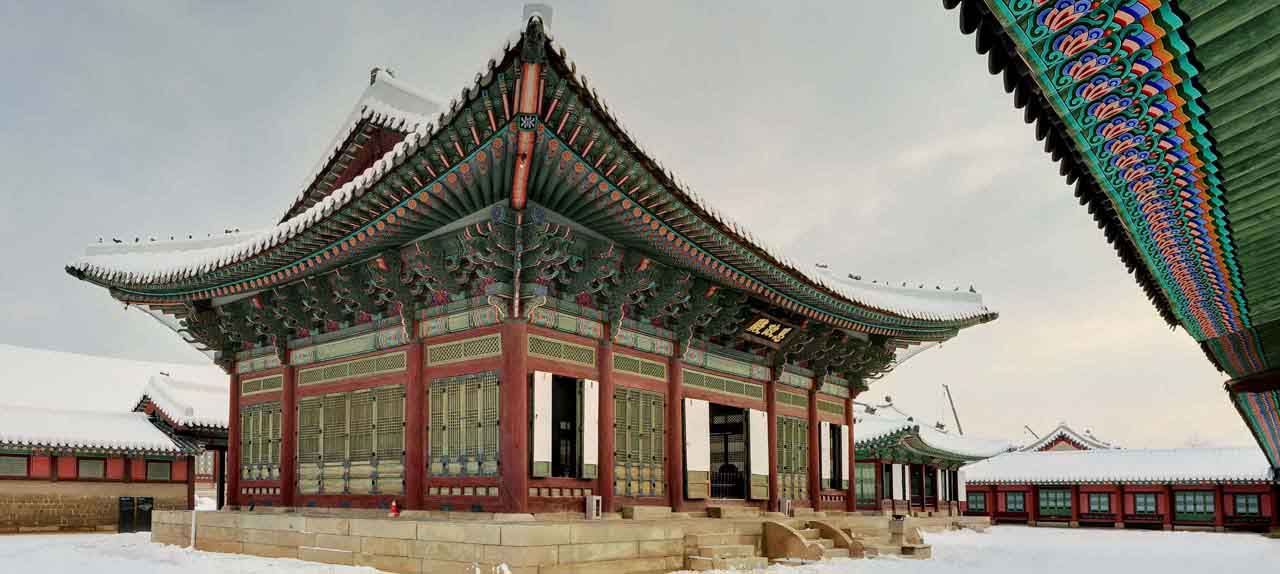
This place is called Sajeongjeon, or Council Hall.It is the office of the king.Every morning, the king held a cabinet-level meeting here.In these meetings, state policies were decided through persuasion and agreement.Officials did not always automatically defer to the king just because he was the king.The king had to present his case to his officials in a logical manner, and persuade them to find a point of compromise.All of this discussion was recorded in real time.The king could not meet with anyone unless he was accompanied by the court scribes.This is why both the king and his officials had to be careful about their words at all times.The following story illustrates some of the challenges of always having scribes nearby:One day, King Taejong, who was an accomplished rider, went out hunting and fell off his horse. The first thing he said afterwards was, “Don’t let the scribes know about this.”Taejong didn’t want to embarrass himself to his descendants by having this incident recorded.The scribes recorded the incident exactly as it had happened.In addition to the scribes’ constant presence, the king was constrained in other ways. For example, although Joseon was an absolute monarchy, the king could not look at the records at will.Also, the scribes never signed their names on the records.This was to allow them to be as honest as they wished.Their records are the Annals of the Joseon Dynasty and the Seungjeongwon Diaries.These two records were acknowledged for their reliability, objectivity and historicity and were made into UNESCO Memories of the World in 1997.Basically, two world cultural heritages were formed in this small space. Joseon officials placed such enormous emphasis on historical records to enable their descendants to objectively evaluate the past.Also, descendants can look at past records for help on how to solve a particular problem.The king who did the most work in this place by far was King Sejong the Great.He is the most respected of all figures in Korean history.
Audio Guide
Sajeongjeon Hall
Loading...
0:00 / 0:00
No audio yet
Photo Gallery