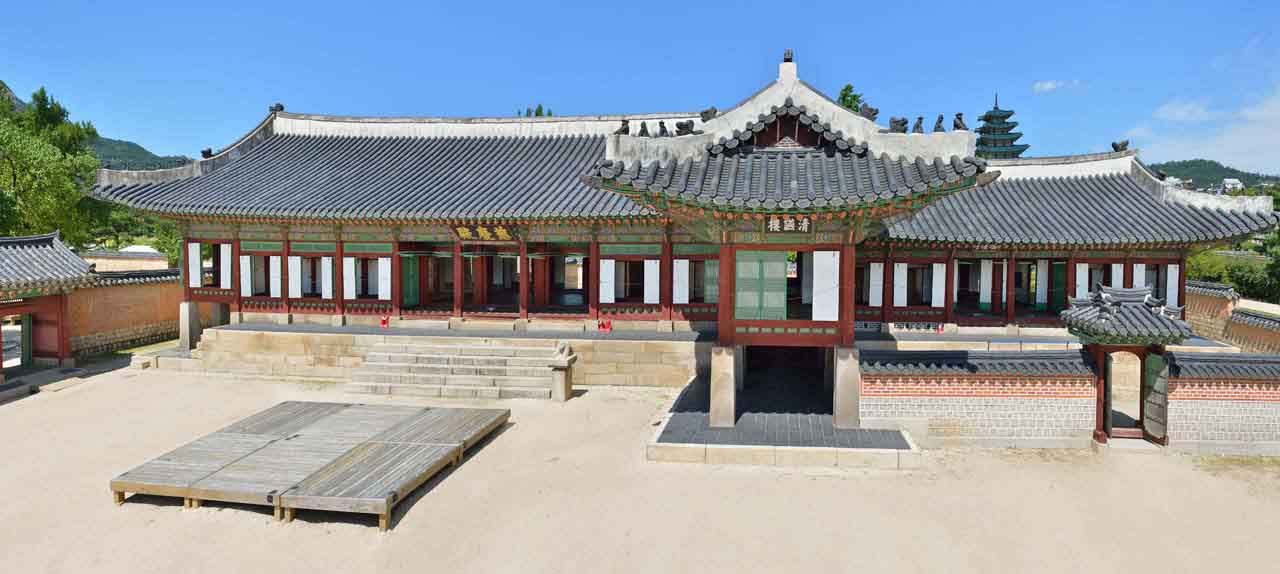
Jagyeongjeon is the mother's house. 'Jagyeong (慈慶)' means 'may blessings be upon mother.' Joseon was a Confucian society, and filial piety was the most important virtue. This hall was built as a symbol of that filial piety.
Jagyeongjeon was built for Queen Sinjeong, for whom Heungseon Daewongun adopted King Gojong as his son and had him ascend the throne. In Joseon history, five dowagers ruled as regents — when a young king ascended the throne, the highest elder of the royal family handled state affairs in her capacity. Jagyeongjeon is a space built in the name of filial piety, behind such power.
In the backyard of Jagyeongjeon is a beautiful chimney with the ten longevity symbols (sipjangsaeng) pattern laid on neatly baked bricks. Chimney normally becomes dirty and turns black, so it is not pleasant to look at. Our ancestors solved this problem by making the Jagyeongjeon chimney blend with the wall so it would not look like a chimney, while also carving various patterns on it — a display of wisdom.
In the large rectangular area in the center of the chimney, many patterns are carved. Sun, clouds, mountains, stones, crane and deer, turtle and immortality mushroom, pine tree and water. These are called the ten longevity symbols. Around the ten longevity symbols, lotus flowers, ducks, and grape clusters are harmonized. These patterns are called auspicious patterns (gilsangmun). Above and below this beautiful canvas, there are large bricks with haetae, dragons, cranes, bats, and bulgasari in relief. These too express the wish to invite blessings, pray for longevity, and prevent evil energy from entering.
Standing in the backyard of Jagyeongjeon today, the chimney of ten longevity symbols stands with the pond behind it. The dowager queen's heart praying for longevity is carved into each brick.
Following the east wall of Jagyeongjeon, a flower wall appears.
Jagyeongjeon was built for Queen Sinjeong, for whom Heungseon Daewongun adopted King Gojong as his son and had him ascend the throne. In Joseon history, five dowagers ruled as regents — when a young king ascended the throne, the highest elder of the royal family handled state affairs in her capacity. Jagyeongjeon is a space built in the name of filial piety, behind such power.
In the backyard of Jagyeongjeon is a beautiful chimney with the ten longevity symbols (sipjangsaeng) pattern laid on neatly baked bricks. Chimney normally becomes dirty and turns black, so it is not pleasant to look at. Our ancestors solved this problem by making the Jagyeongjeon chimney blend with the wall so it would not look like a chimney, while also carving various patterns on it — a display of wisdom.
In the large rectangular area in the center of the chimney, many patterns are carved. Sun, clouds, mountains, stones, crane and deer, turtle and immortality mushroom, pine tree and water. These are called the ten longevity symbols. Around the ten longevity symbols, lotus flowers, ducks, and grape clusters are harmonized. These patterns are called auspicious patterns (gilsangmun). Above and below this beautiful canvas, there are large bricks with haetae, dragons, cranes, bats, and bulgasari in relief. These too express the wish to invite blessings, pray for longevity, and prevent evil energy from entering.
Standing in the backyard of Jagyeongjeon today, the chimney of ten longevity symbols stands with the pond behind it. The dowager queen's heart praying for longevity is carved into each brick.
Following the east wall of Jagyeongjeon, a flower wall appears.
Audio Guide
Jagyeongjeon Hall
Loading...
0:00 / 0:00
No audio yet
Photo Gallery

