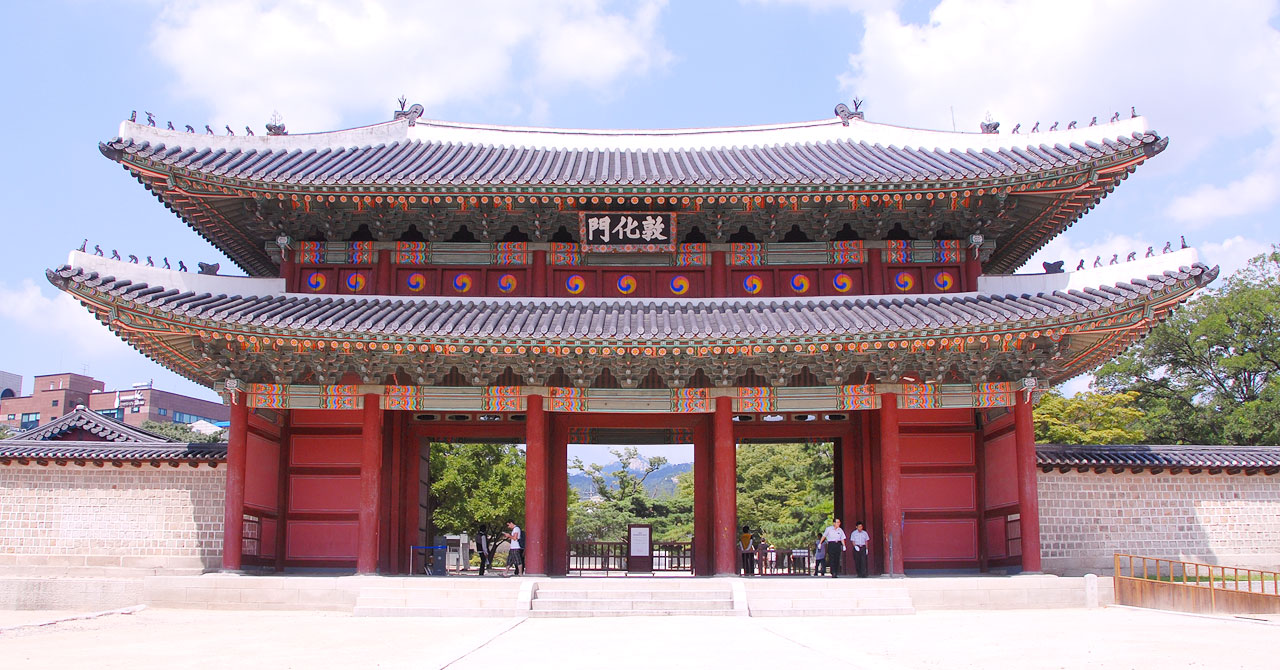
This is Donhwamun Gate, the front gate of Changdeokgung Palace. It was only used by the king, or during large state celebrations. The center gate was only accessible by the king, and high officials used the gates to its sides. 'Donhwa' means 'the king moves his people through great virtue', and symbolizes the Joseon kings' will for virtue and ethics over punishment. Donhwamun is placed on a high stone platform called a Woldae, and if you come down a bit to the street, you can see the king's road, Eodo, stretching from it. The soldiers guarding Donhwamun watched the sides of the gates, and also passers-by from the second floor of the structure. In 1413 right after the gate was finished, a 9000kg bronze bell was placed on the second floor, to solemnly announce dawn and evening. There was once also a large drum called Eomgo. It was used to alert officials of the king's arrival and leave. There are two small gates, called the Dangbongmun and Geumhomun. The Donhwamun was used during large ceremonies, and normally, government officials and soldiers had to enter through the smaller gates on the sides. There was a strict policy concerning how one entered the palace. The gates were meant to be opened at the exact hour, but the times could be changed if there was an important reason to enter or leave. People were required to carry a permit in order to enter. Can you see the eight locust trees growing here? In Korea, living things with high academic or aesthetic value are selected and protected as natural monuments, and the trees are all designated as natural monuments. It was a tradition to plant such locust trees in palaces and the homes of confucian scholars. They were also called scholar trees in the west, as the freely stretching branches symbolized the wide range of academics. They also signify the highest ranking officials who ran the country.
Audio Guide
Donhwamun Gate
Loading...
0:00 / 0:00
No audio yet