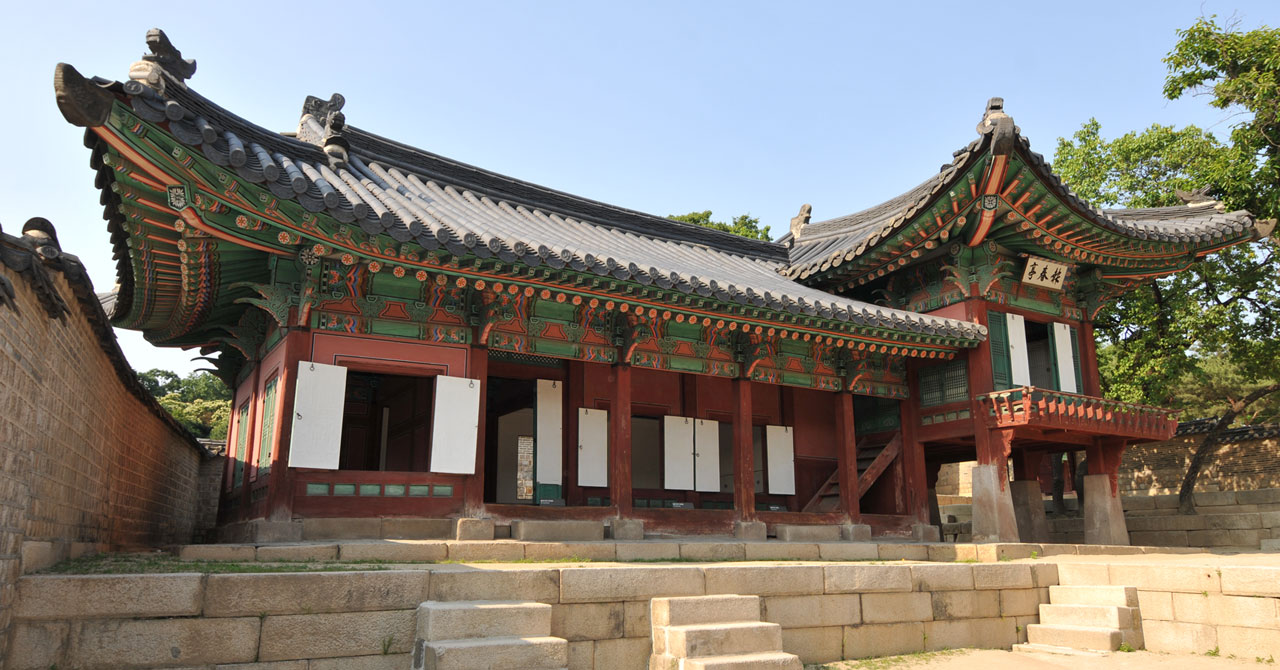
This is the Seongjeonggak Hall, the crown prince's area. Buildings related to the crown prince are often called the Donggoong, because they were situated on the East side of the palace. This is because the crown prince, as the future king, was regarded as the sun just before its rise. What you are seeing now is Seongjeonggak, the study room of the crown prince. Seongjeong is one of the ideal political principles that appear in Confucian texts, and means reaching enlightenment and throwing away what is false and keeping only what is true. This is a fitting name for a place for a future king to be. The crown prince would have three Confucian text lessons a day here, and learned six lessons on etiquette, playing instrument, archery, horseback riding, calligraphy, and mathematics. The crown prince's education continued from morning to night, and there were tests to check what he had learned, often by the king himself. On the building across the Seongjeonggak, there is a signboard that says ‘making the medicine for the king’ or ‘protecting the king’s body'. Also, there is a stone mortar in the yard, which was made to make the medicine. This shows remnants of the Japanese rule era when the Seongjeonggak was refitted as a royal hospital. Do you see the small building attached at a right angle to Seongjeonggak? Stories tell of how Joseon had experienced a drought for a few months during the building's construction, which ended with a lot of rain after its completion. Now you can see why the place was named Huiwu, which means 'welcoming rain'.
Audio Guide
Seongjeonggak Hall
Loading...
0:00 / 0:00
No audio yet
Photo Gallery
