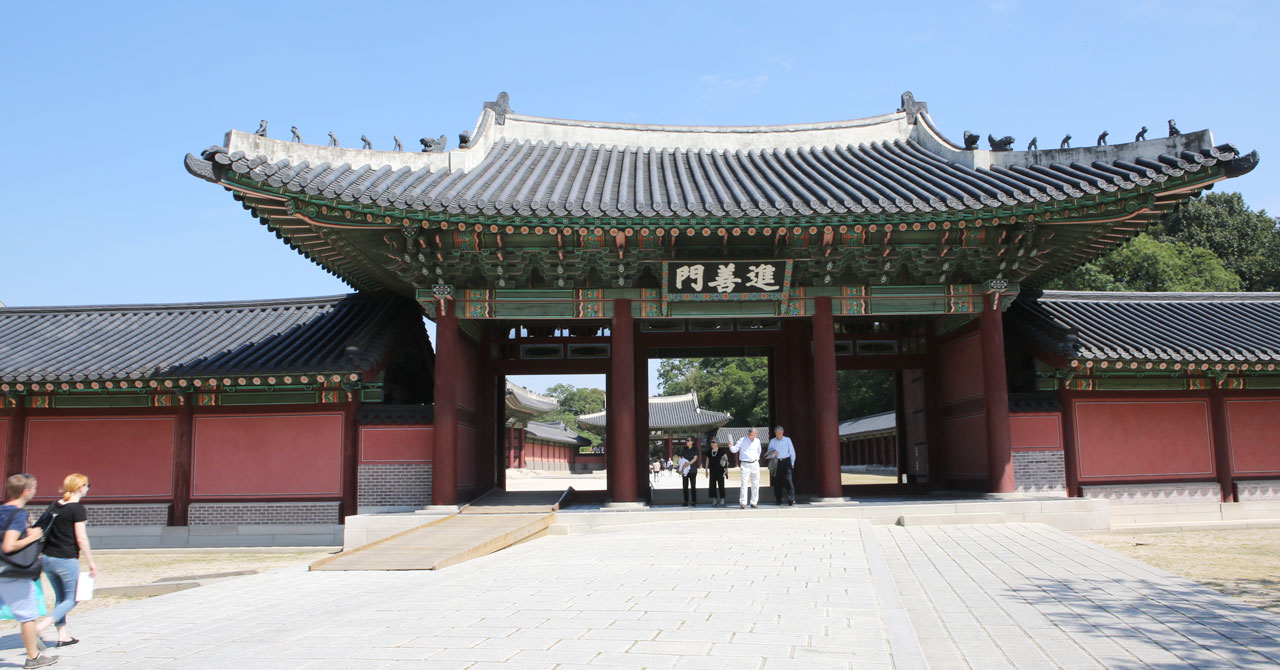
The large gate you are now seeing is Jinseonmun. The name 'Jin Seon' means 'speaking true words with the king'. As this is the entrance to the throne where the king sits, it carries the wish for a virtuous rule. During king Yeongjo's reign in the mid-1700s, the Shinmungo was situated here. It was a large drum which people could hit when they were the subject to a misdeed, and wished to beseech the king's wisdom. Once you enter through Jinseonmun, you reach a large yard that has Injeongmun Gate to the left, and Sukjangmun Gate to the front. There are three stone roads on the center of this yard, called Samdo. The center road is Eodo, which only the king could use; officials used the two roads on Eodo's right and left. The left yard of Samdo, connected to Injeongmun, is shaped like a trapezoid, slightly tapering towards the Sukjangmun. This is quite unique among Korean palaces, which normally have straight and square yards. In most palaces, the route to the king's quarters is normally straight from the front gates, but in Changdeokgung Palace, you have to enter through Donhwamun Gate and make a right turn over Geumcheongyo Gate, and make another right turn through Injeongmun in order to reach Injeongjeon Hall, where the king stays. We can take a peek into the environmental considerations that was put into the palace's construction, rather than emphasizing royal power through a straight path of buildings.
Audio Guide
Jinseonmun Gate
Loading...
0:00 / 0:00
No audio yet
Photo Gallery
