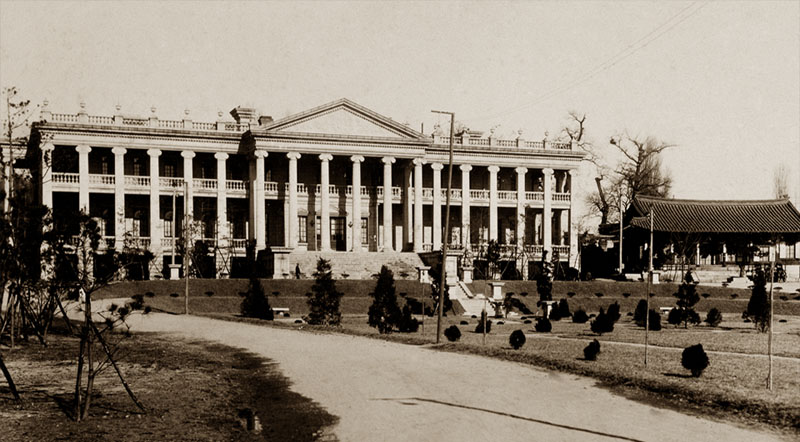
Seokjojeon Hall is a western style Royal Palace that indicates Emperor Gojong’s active attempts to adopt advanced western culture and civilization for the modernization of the Korean Empire. Seokjojeon (Stone Palace Hall) was named because of the materials used to build it. Instead of the traditional architectural materials such as wood and mud, stones were used. Emperor Gojong used this place to greet important guests from other countries and for his office administration. The construction of Seokjojeon began in 1900 and ended in 1910 when the Korea-Japan Forced Annexation occurred. Because it was completed towards the end of the Korean Empire era, it was never fulfilled its purpose. The plum flower pattern, a symbol of the Korean Empire, at the top front of the building shows that it is a building of the Korean Empire. During the Japanese colonization, King Yeongchin used this place as his residence whenever he returned to Korea. After the liberation from Japan, the US-Soviet Joint Commission Meeting was held here, and also it was used as a national museum of Korea and an art museum. Seokjojeon Hall is now open to the public as the Daehan Empire History Museum.
Audio Guide
Seokjojeon Hall
Loading...
0:00 / 0:00
No audio yet
Photo Gallery


